Natural Supplements
How to Choose a Sea Buckthorn Product: 6 Questions to Ask Before Buying
05 Sept 2026 • Riddhi Jain
Why the question needs asking at all
Sea buckthorn has moved quickly from an obscure Himalayan berry to a category with a growing number of brands. That growth has outpaced the supply of Indian fruit, and the two facts sit uncomfortably together.
Ladakh accounts for roughly 13,000 hectares of India's sea buckthorn, with a mean annual harvest of around 231 tonnes, in a crop that fruits once a year. India's total planted area is around 20,000 hectares. China, for comparison, has about 2.07 million hectares and roughly 90 per cent of the world's resource.
A short season and a limited harvest place a real ceiling on how much genuinely Ladakh-sourced product can exist in any given year. Import records are public data for anyone who wants to check what is arriving from where.
1. Where does the fruit come from?
Provenance should be stated specifically, not gestured at. Himalayan is a region; Ladakh is a source. Ask which, and whether the brand can evidence it.
2. Is there organic certification?
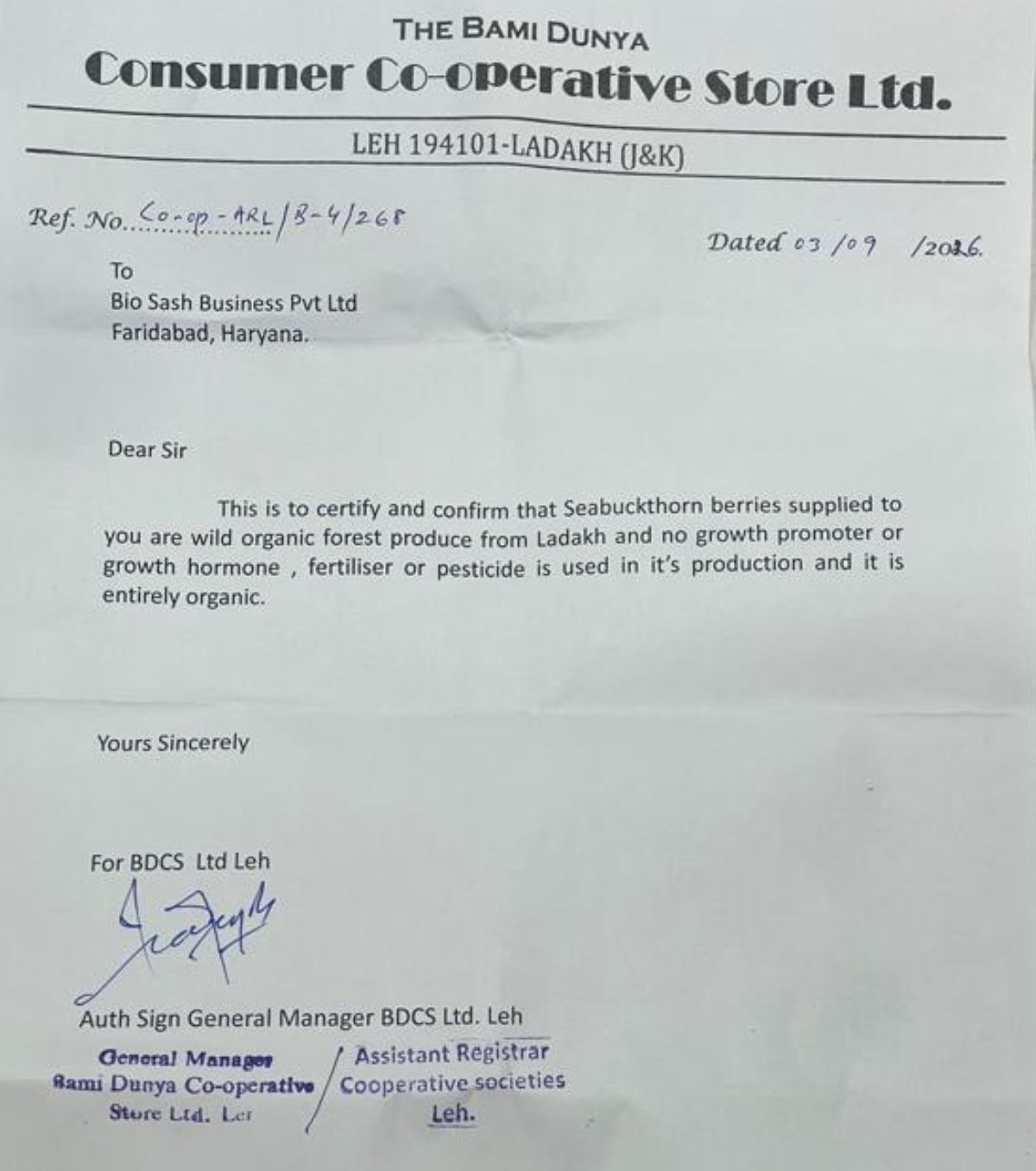
Certification is a document, not an adjective. It can be produced on request, and a brand that has it will usually show it without being asked twice.
3. How is it processed?
This is the question that separates products most sharply, and the one least often asked. Sea buckthorn's constituents include heat-sensitive compounds, and a berry that is picked and packed without appropriate processing does not deliver what the fruit contained.
There is no single correct method, but there should be a method, and a brand should be able to describe it rather than treat it as a trade secret that conveniently cannot be discussed.
4. Pulp oil, seed oil, or juice?
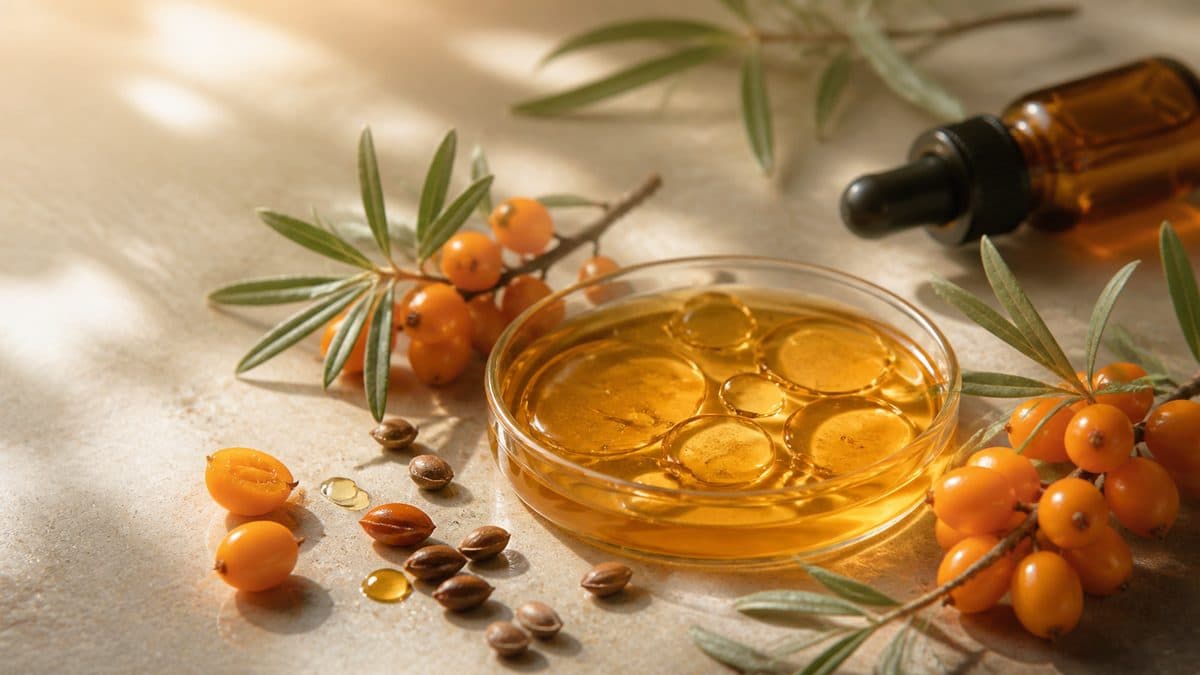
These are not interchangeable. Seed oil and pulp oil come from different parts of the same fruit and carry different fatty acid profiles; juice carries the water-soluble fraction, including vitamins and antioxidants.
A product labelled simply sea buckthorn oil, without saying which, is not telling you what you are buying.
5. Who does the research and the manufacturing?
A brand with its own R&D and its own manufacturing controls what happens to the fruit. A brand that contracts both out is dependent on somebody else's decisions and may not know what those were.
6. Does it work for you?
The most useful test is the one you can run. Take a baseline before you start, whether that is a blood test you were due anyway or simply an honest note of how you feel and sleep. Give any product a fair run, and reassess.
If nothing has changed after a reasonable trial, that is information. It may mean the product is not right for you, or that something else needs attention first.
Where we stand on our own list
It would be unreasonable to publish these questions without answering them. Biosash sources from Ladakh and holds organic certification; processing is done on methods the company has developed and protected; R&D and manufacturing are in-house; and products are specified by fraction, so pulp oil, seed oil and juice are sold as distinct things rather than as a single undifferentiated oil.
We would rather be judged on those answers than on adjectives. The same questions are worth putting to anyone selling this berry, ourselves included.
The sourcing and wild-organic declaration for those berries is issued by the Assistant Registrar of Co-operative Societies cum General Manager, Bami Dunya Consumer Co-operative Store Ltd, Government of the Union Territory of Ladakh, Leh, and dated 3 September 2026. It is here, alongside the rest on our certificates page. Asking to see it is exactly what this article is recommending you do.
Watch the full conversation
This article draws on Arjun Khanna, Managing Director of Biosash, in conversation with Amiett Kumar on the Readers Books Club podcast.
This guide is about how to evaluate products and is not medical advice. Anyone with an existing medical condition, or taking prescribed medication, should speak to their doctor before adding a new supplement to their routine.