Health and Wellness
The History of Sea Buckthorn: From Himalayan Herb to Modern Superfruit
13 Sept 2026 • Amisha Surana
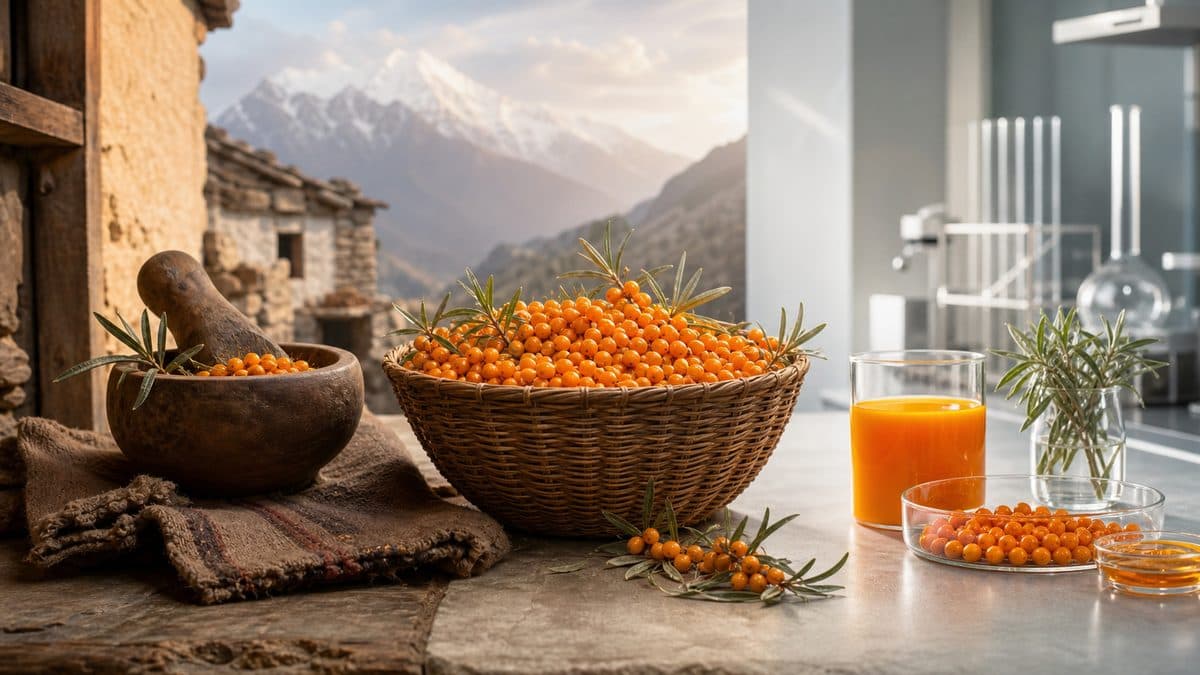
Sea buckthorn was a survival plant long before it was a wellness product. In Ladakh, Spiti and the high valleys of Himachal Pradesh, it grows as a thorny shrub in places where very little else will, holding poor soil together through frost, drought and thin air. The bright orange berries were food, and the plant itself was fuel, fencing and erosion control.
Its journey to a bottled juice is really a story about accessibility. The fruit was always nutritious. What changed is that it stopped requiring you to live at high altitude and to fight your way through a thorn bush to get any.
Why Sea Buckthorn survives where little else grows
Hippophae rhamnoides is a hardy shrub of cold, high-altitude regions. It fixes nitrogen through its roots, which is why it can colonise ground that has been stripped bare, and it tolerates temperature swings that would finish most fruiting plants. In India it is found largely in Ladakh, Himachal Pradesh and Spiti.
The berries themselves are small, intensely orange and packed tightly along thorny branches. Anyone who has harvested them by hand will tell you it is unpleasant work. The fruit is also fiercely sour, which is characteristic of the berry rather than a fault, and which explains why it was traditionally processed rather than eaten by the handful.
How Sea Buckthorn got its name
The botanical name is often explained as coming from words meaning shining horse, a reference to an old association between the plant and the condition of horses that grazed near it. Whether or not you take that etymology at face value, it points to something real: the plant was noticed and named by people who lived with it, not discovered by a marketing department.
Local names across the Himalayan belt vary from valley to valley, and in Ladakh it has long been simply a familiar part of the landscape, gathered in season, made into juice or preserves, and used in the household without ceremony.
Traditional use in Himalayan and Tibetan practice
Sea buckthorn has a long history of traditional use in Himalayan, Tibetan and Ayurvedic practice. In those systems the berry, the leaves and the oil all had their place, and the plant sat comfortably in the overlap between food and preparation, which is where a lot of Himalayan botanicals live.
The context matters. In a landscape where fresh green vegetables are unavailable for a good part of the year, a dense, sour, vitamin-rich berry that ripens in autumn and stores well is not an exotic supplement. It is a practical answer to a long winter. Much of the plant's traditional standing comes from that straightforward usefulness.
From wild shrub to cultivated crop
For most of its history sea buckthorn was gathered from the wild. Two things gradually changed that in India. First, the plant's value in stabilising slopes and reclaiming degraded high-altitude land was recognised, which led to deliberate planting. Second, growers and small enterprises in Ladakh and Himachal Pradesh began treating the berry as a crop with a market rather than only as household food.
That shift brought its own problems worth being honest about. Harvesting remains difficult and labour-intensive. The season is short. And the fruit is delicate once picked, which makes handling and processing a genuine constraint rather than an afterthought. These are the reasons sea buckthorn products cost what they do.
How Sea Buckthorn became a modern superfruit
The superfruit label is a modern marketing category, and it has been attached to plenty of ordinary things. In sea buckthorn's case the underlying nutrition is unusual enough to explain the interest, and it is a large part of why the berry ended up with a reputation as the Himalayan wonder berry.
It is one of very few plant sources containing Omega 3, 6, 7 and 9 together, and it is notably rich in Omega-7, or palmitoleic acid, which is uncommon in plants. It is a good source of Vitamin C and also contains Vitamin E, carotenoids including beta-carotene, and flavonoids. It is naturally low in sugar. That combination in a single fruit is rare, and it is why the berry moved from a regional staple to a national shelf. People now include it in their routine as part of a general approach to nourishment and everyday immunity support, in the sense of eating a nutrient-dense diet.
What modern processing changed
Turning a fragile, seasonal, thorn-guarded berry into something you can pour from a bottle in Mumbai in May is the real modern contribution. Careful pressing and cold handling protect the more delicate nutrients, and proper manufacturing standards make consistency possible from one batch to the next. It is also what makes the choice between a daily glass and a capsule possible at all, since both formats depend on the same careful handling of the same short harvest.
The honest test for any brand is whether it says where the fruit comes from and how it is checked. Biosash sources Himalayan sea buckthorn, manufactures under WHO-GMP certified manufacturing, and batch tests at a NABL-accredited laboratory, with no added sugar and no artificial colours, flavours or sweeteners across the health care range. Usage is straightforward: 10 ml morning and evening, mixed in water, about twenty minutes before meals. If you take regular medication, mention a new daily supplement to your doctor.
That part of the story has its own dates. The herbal work behind those products began in 1993, when the late Mr. Ramesh "Nico" Khanna established the company's herbal manufacturing facility. What followed made it one of the pioneers of sea buckthorn products in India, and those products have since been exported to the USA, the UK and the Middle East. It is a useful reminder that the berry's move from the high valleys to a national shelf happened over decades of slow, unglamorous manufacturing work rather than in a single season.
What has not changed is the berry. It is still sour, still stubborn, still growing in cold places most people never visit. The bottle is just the modern way of getting it down the mountain.